Resources
Presentation animations
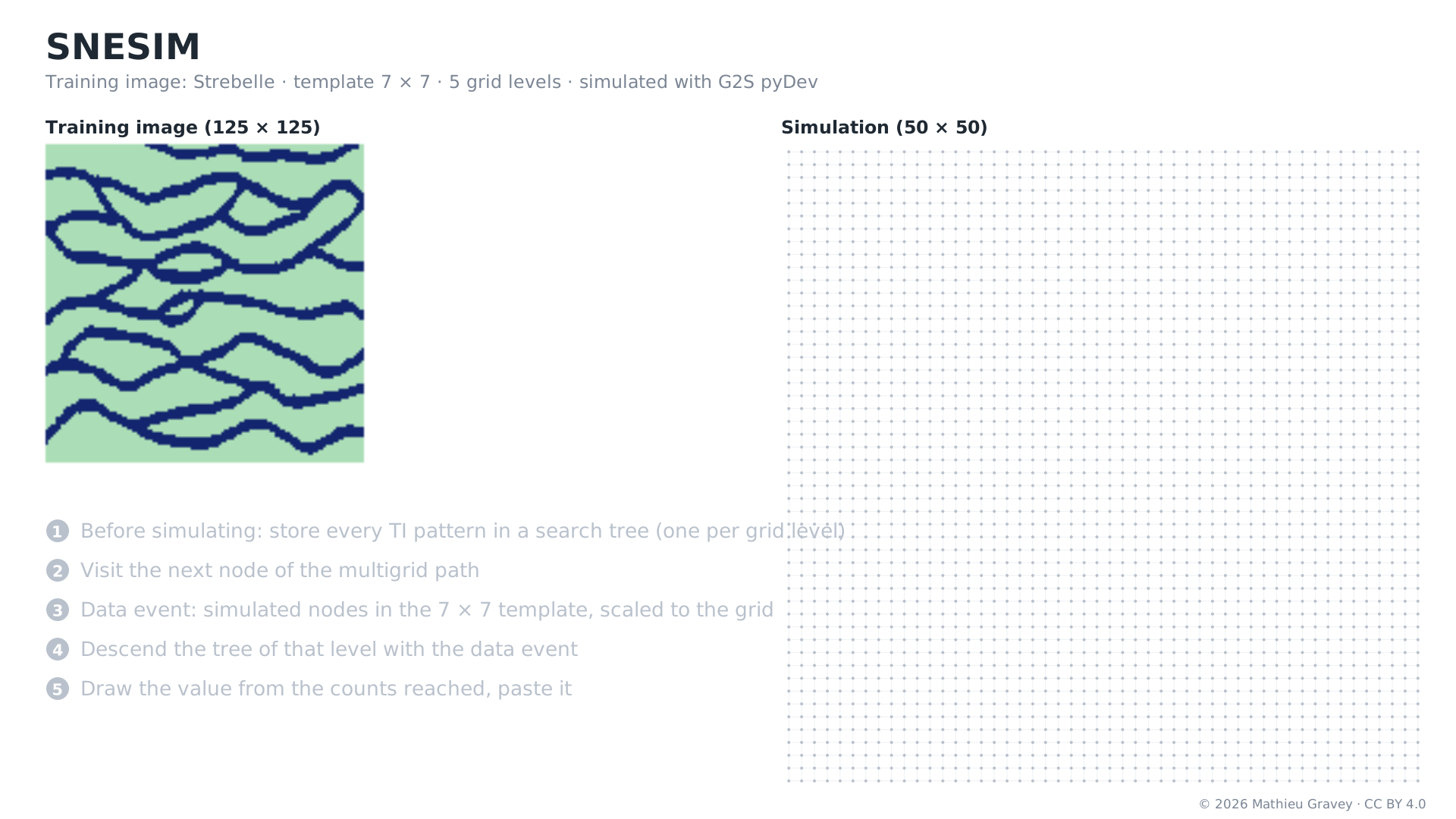
These animations show how a sequential simulation works, one node at a time: visit the next node of the path, collect its data event, search the training image (or the SNESIM search tree), and paste the value. They replay real simulations: the algorithms ran through pyDev, which logged every step, on a 50 × 50 grid.
The animations follow the light or dark appearance of your system; the switch under each one changes it. Each one can be downloaded as an animated SVG (for web pages) or as a video (MP4, 1920 × 1080, for slides; PowerPoint does not play animated SVGs). They can be regenerated, or made for other settings, with the scripts in example/python/pydev/animations.
Licence. The animations are © 2026 Mathieu Gravey and are licensed under CC BY 4.0: you can use, share and adapt them, including in slides, courses and publications, as long as you give credit. Suggested credit: © 2026 Mathieu Gravey · CC BY 4.0. The author and licence are shown in the corner of each animation and written in the metadata of each SVG and video file.
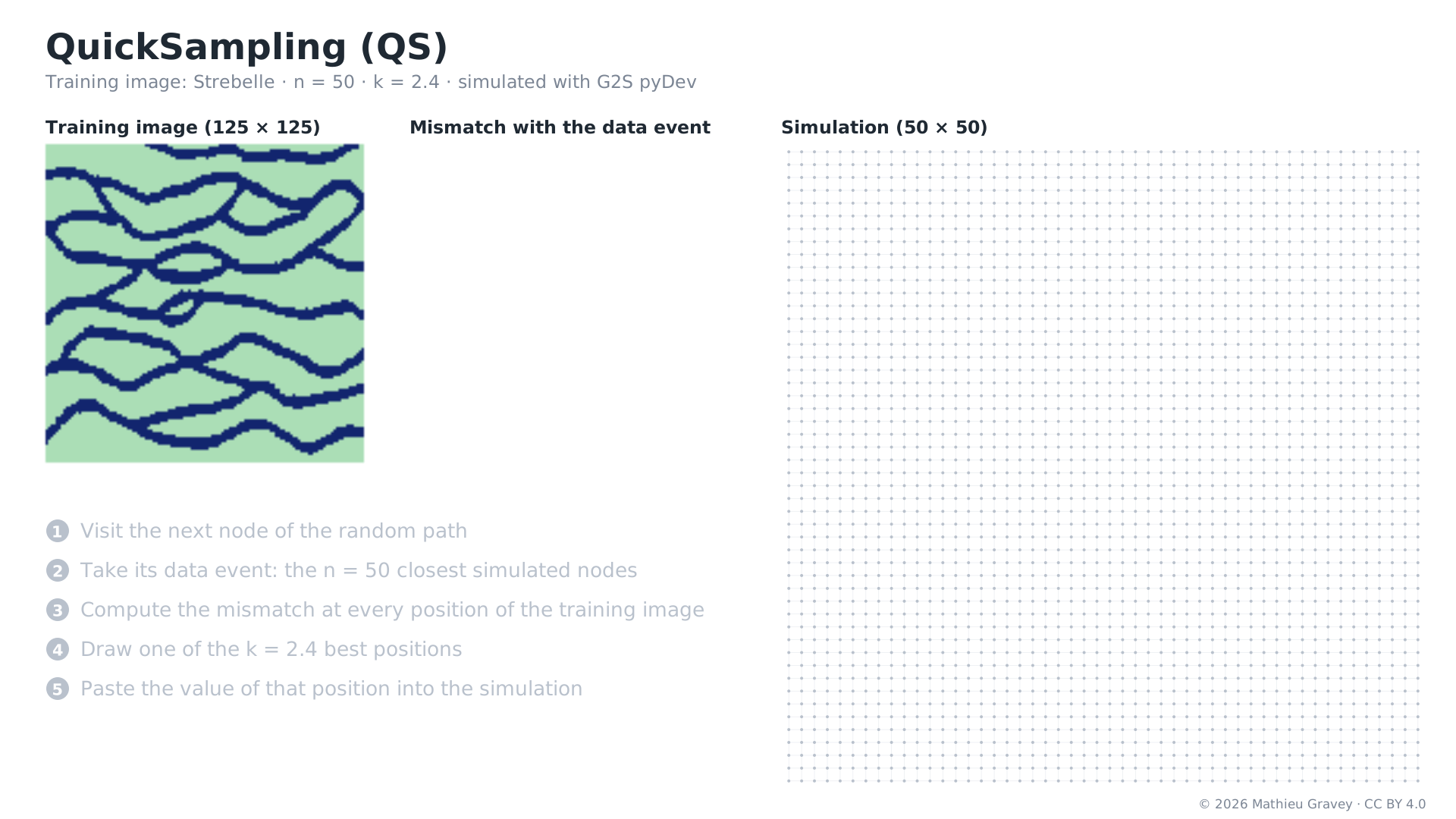
QuickSampling, Strebelle training image
For each node, QS compares its data event with every position of the training image and draws one of the k best positions (n = 50, k = 2.4).

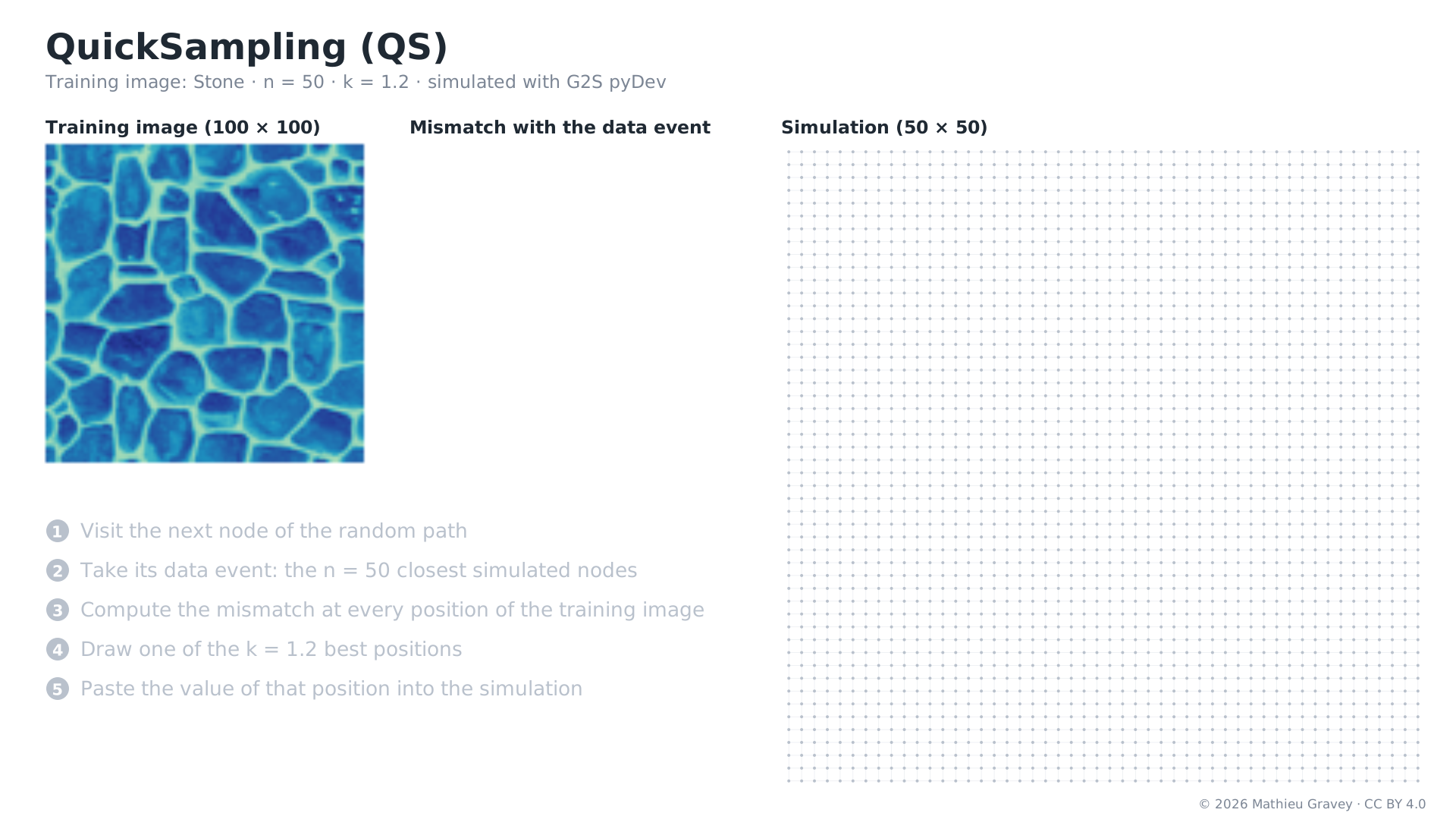
QuickSampling, stone training image
The same steps with a continuous variable; the mismatch is the mean squared difference over the neighbours (n = 50, k = 1.2).

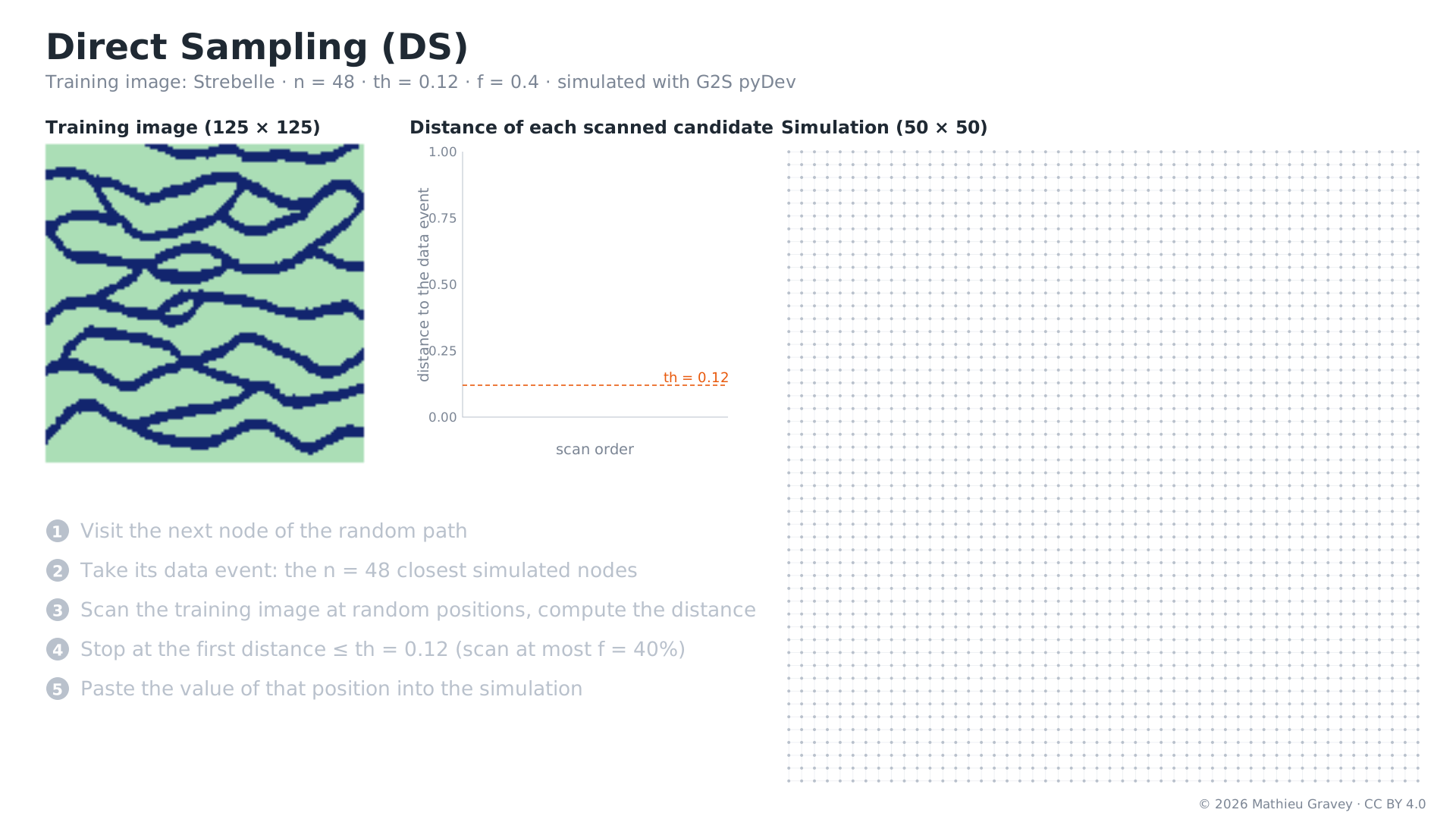
Direct Sampling, Strebelle training image
DS scans the training image in random order and accepts the first candidate whose distance is under the threshold (n = 48, th = 0.12, f = 0.4).

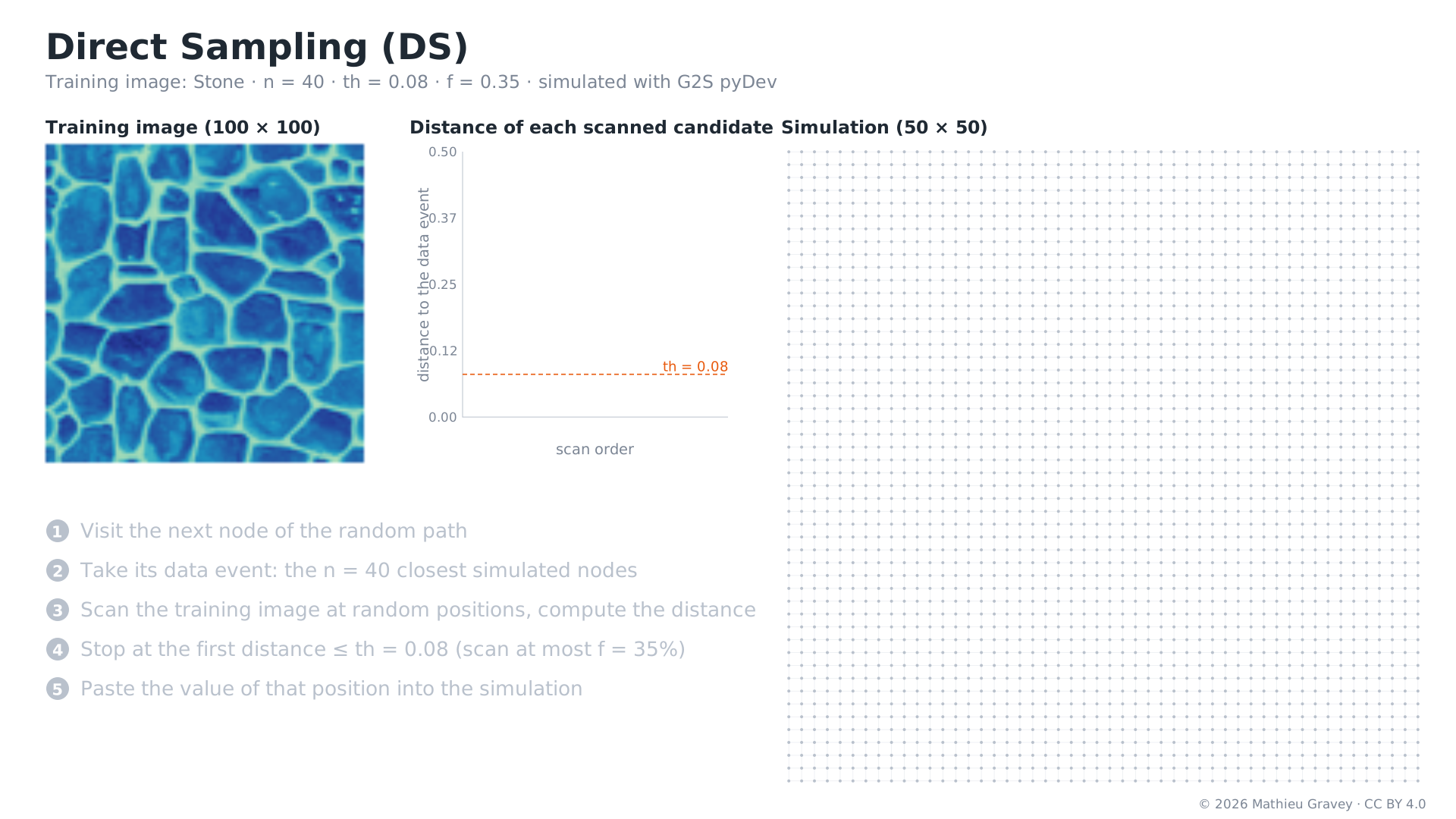
Direct Sampling, stone training image
With a continuous variable, DS often scans the whole fraction f without finding a candidate under the threshold, and keeps the best one (n = 40, th = 0.08, f = 0.35).

SNESIM, Strebelle training image
SNESIM first stores every pattern of the training image in a search tree, one per grid level; each node then only descends the tree with its data event and draws its category from the counts (template 7 × 7, 5 grid levels).